
Check us out on Instagram or Facebook!


There is no such thing as intrinsic value. An audible cringe radiates from my face every time I hear this term, a reflex made all the worse when a professional uses it to describe a financial asset.
Gold is not worth something because of some idiosyncratic quality that demands sovereignty over the other periodic elements. “But it’s beautiful and rare!” Yes, to humans stuck on earth, but not in every historic culture. Explain why dogs prefer sticks over gold.
Don’t we know that money is nothing more than a man-made technology? Absent human experience, no element or composite is more useful than the other. They would all be equally useless.

Imagine you are in a kayak in the middle of a lake, and a salesman approaches you with an offer to sell you a bucket of water. It would be a terrible offer with a potentially negative worth. Especially if your kayak was of particularly poor quality.
Now, imagine you are in the middle of the Mojave Desert with no sign of human civilization and a 110-degree heat index under the midday sun. You might be willing to give your life savings for the same product.
The only difference is the underlying human condition. This is what drives value. Wrapping our gray matter around this truth is the prerequisite for understanding many economic conundrums. Mysteries begin to unfold, such as:
Why the U.S. debt does not seem to matter
Why virtual assets like cryptocurrency (or any digitized currency) are worth anything at all
Why every bull market isn’t a bubble
Why homes are worth more than the sum of their depreciated parts
The price of every asset, product, and service is a signal that links directly to a particular human desire. The thread may be long and tangled beyond a discernible path, but it ultimately terminates into an outstretched hand.
These desires vary from essential for survival (food, water, and shelter) to essential for ego (cars, zip codes, and jewelry). The more desires a thing serves, the more convoluted its pricing.
Publicly traded equities are notoriously challenging when it comes to ascertaining their value. The motives for their exchange are varied and have grown in complexity since their global debut in 1602.
It helps to dissect them into value layers and rank them in terms of quality.
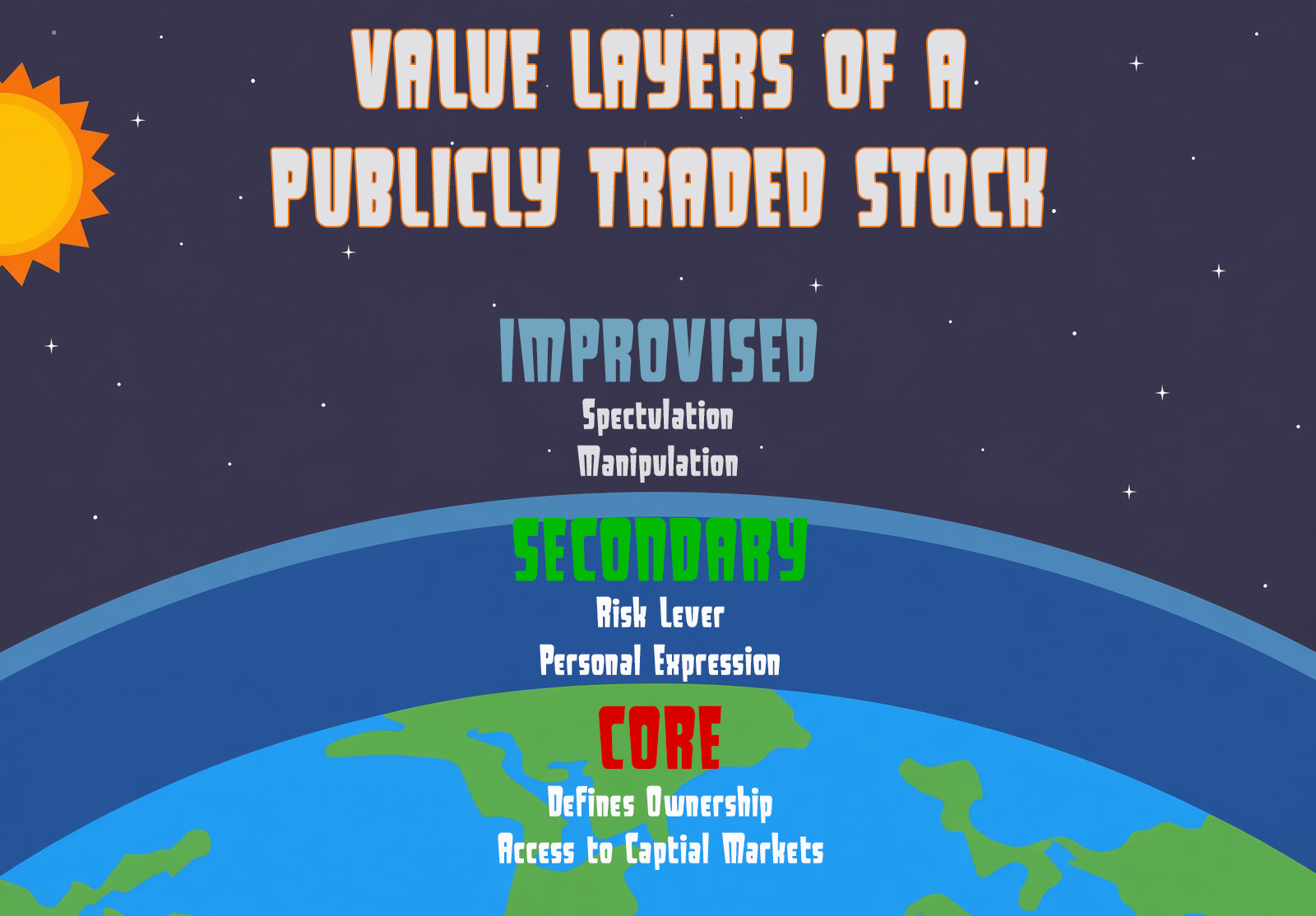
Core Layers (important social utility)
Function to disseminate corporate ownership and therefore profit/loss distribution among a large group of shareholders
Efficient access to capital markets and growth opportunities for investors (think liquidity)
Secondary Layers (personal expression)
Increase/decrease financial risk (e.g., stocks used as an inflation hedge)
Exercise of personal convictions (e.g., buying a stock to support a cause)
Improvised Layers (mostly mala fide uses)
Speculative trading (ignores company fundamentals)
Economic manipulation (e.g., insider trading, short squeeze, hostile takeover)
The improvised layer frustrates equity analysts to no end. There’s no logic to it, only human emotion—mostly greed. This frustration came to a crescendo earlier in the year when two-time Morningstar manager of the year David Giroux wrote in his letter to shareholders:
“It is as if the market woke up on the morning of November 15 (2025) and said, ‘I want to buy the most volatile, highest-risk, lowest-quality companies with the worst fundamentals regardless of valuation.’”
— David Giroux
He is expressing a sentiment shared by many stock investors who have the audacity to do any fundamental research. John Bogle was so frustrated by this desultory nature that he simply gave up and invented the index fund. Thus, the S&P 500 Index fund was born.
Investors could now merrily carry on, worry-free that little to no thought went into their stock selection. It matters little.

Or does it? It sure seemed to matter for prolific investors like Warren Buffett, who made billions with well-thought-out, concentrated bets on individual positions.
I recall a moment during the 2008 Financial Crisis when Mr. Buffett declared, “Buy American. I am.” He proceeded to cherry-pick deals too good to refuse, at least to him at the time. They ended up being very good calls, making him another large fortune.
Perhaps the trick is to be more discerning when the speculators fail to find value in the improvised layer. That’s when the bubble pops, which has the potential to cascade misery throughout all value layers. It can be a rare moment of opportunity.
Buffett’s late counterpart, Charlie Munger, often stressed the point of seizing opportunity when it arises, once stating:
“You only get a few opportunities, and you have to grab them aggressively when they come because even in the most favored life, they’re really rare.”
There seem to be no obvious pockets of deep value today. Retail investors continue to pile into stocks, mostly informed by recency bias and ample liquidity. Fortunately, corporate earnings and employment numbers are healthy, supporting both the core and secondary layers of value.
This is exactly the type of market that frustrated John Bogle enough to just buy everything. I think he was right to do so. Such frustration can also lead to increased and unnecessary risk-taking, something that has been on the rise as David Giroux pointed out last November.
We should keep one eye on speculators and market manipulators—the Beavis and Butthead of financial markets. They are capable of incredibly stupid things. When they do, be ready to take advantage!
Investment advice offered through National Wealth Management Group, LLC. The information presented is for educational and informational purposes only and is not intended as a recommendation or specific advice.
Past performance is not indicative of future performance. All investing involves risk, including the possible loss of principal. Consult a qualified professional regarding your individual circumstances before making any financial decisions.