


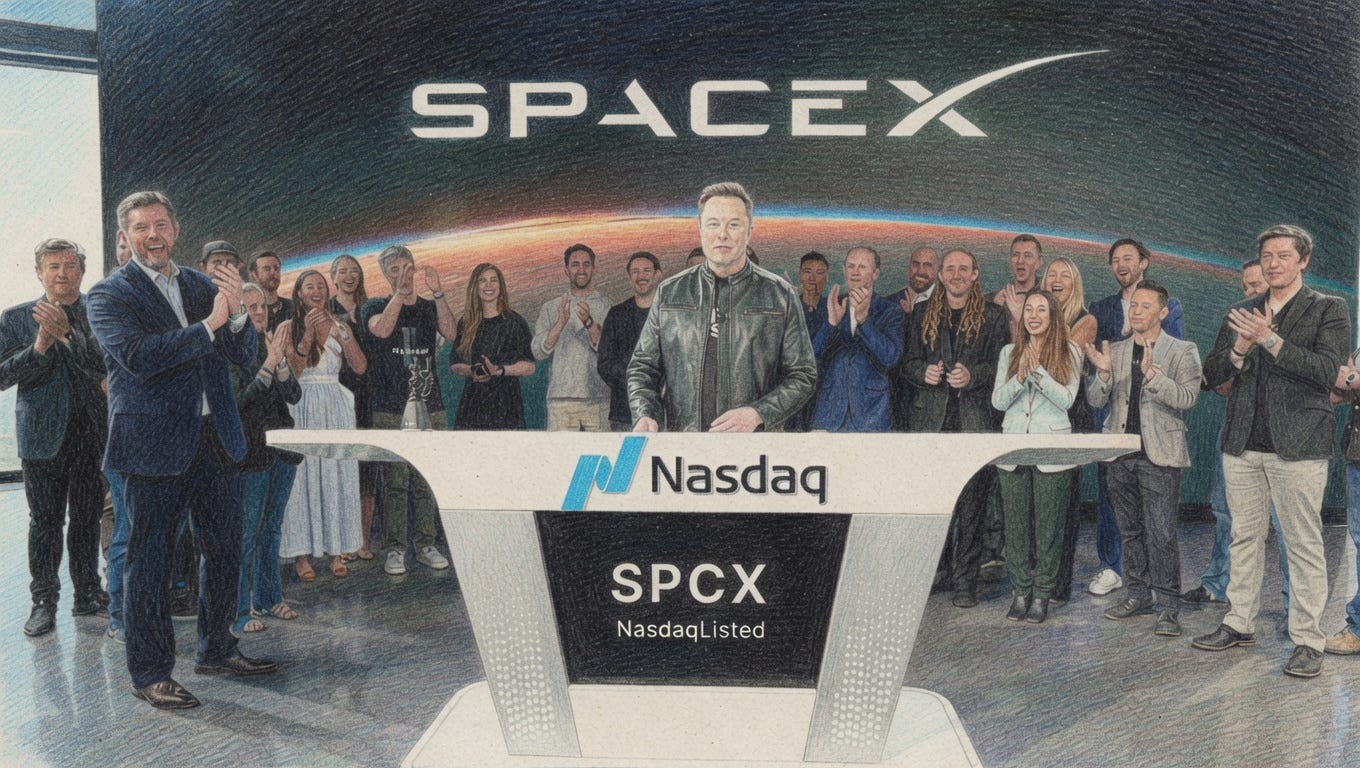
It’s finally here. Months of rumors followed by fevered anticipation after the IPO announcement has led to the biggest IPO in history. The record, previously held by Saudi Aramco at $25.6B in 2019 was obliterated more thoroughly than Blue Origin’s New Glenn rocket.
Raising approximately $75B selling a massively oversubscribed IPO at $135 per share priced on June 11th, it will be a tough record to break. Even for heavy weight Anthropic, the next anticipated banger IPO.
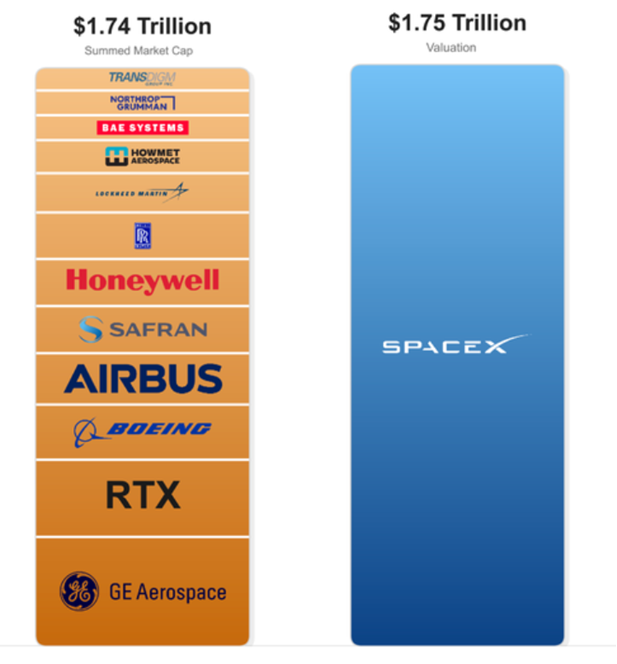
This puts the SpaceX post-IPO valuation at around $1.75 trillion to $1.77 trillion initially, with shares popping on its June 12 debut pushing the market cap north of $2 trillion at times. To put that in perspective, it’s bigger than most of the S&P 500 heavyweights on day one.
Demand was reportedly four times oversubscribed, fueled by retail frenzy and institutional demand. The rumors that much of this stemmed from index funds forced to buy the position due to accommodating rule changes is largely untrue1.
Many indexes did accommodate by adding fast-track rules, but all still require a seasoning period and a market capitalization threshold2. Fund allocations into the new stock will be added over the next several days and months, however this is not what fueled day one purchasing.
Behemoth S&P and Dow Jones Indices did not bend their rules at all, meaning investors within associated index funds will not see allocations into SPCX until at least the middle of next year (and only if profitable).
What made this IPO unusual was SpaceX’s deliberate push for broader retail participation. Traditionally, retail gets a measly 5-10% of mega-IPOs. Here, the company aimed for up to 30% of the offering for individual investors and worked directly with platforms like Robinhood, Fidelity, Charles Schwab, SoFi, and E*Trade.
Interested investors would submit conditional offers to purchase shares by the June 11th pricing date and wait to find out how much they would get. For clients of Charles Schwab, the number of shares received largely depended on how strong the relationship was. I guess loyalty has its benefits.
Most custodians (e.g. Robinhood, SoFi, E*Trade & Fidelity) used a lottery formula versus a first-come-first-serve method. On average, ~18% of retail share allocation requests were fulfilled. Small, but still a historic shift for retail investors.
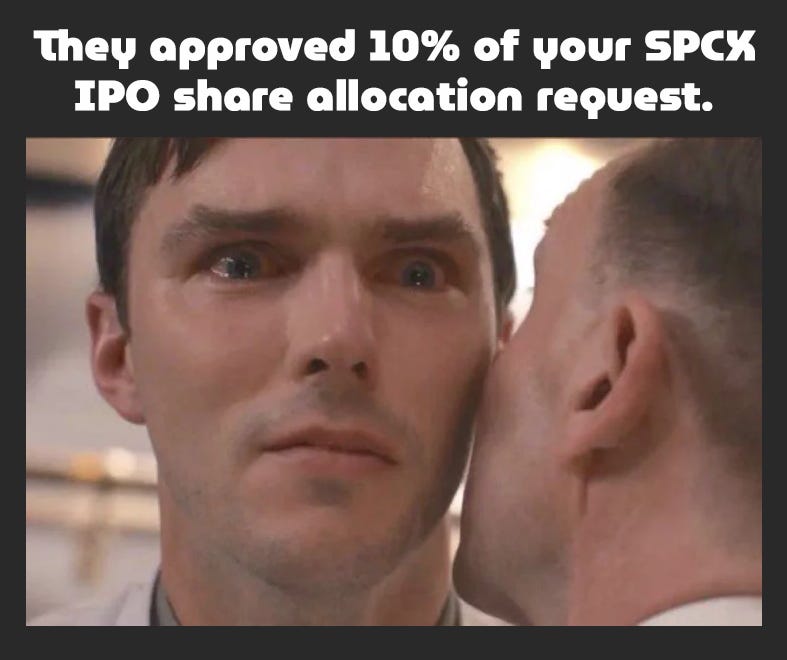
Reddit threads were abuzz with live reports of users wanting hundreds of shares only to get a handful, often 5-15% of their ask. One guy with a Fidelity account (Reddit u/rossgivens) wanted 370 and only landed 10. The lottery method may be democratized, but supply was still brutally tight with a tiny initial float.
This wasn’t charity, but part of a strategic plan to propel share price beyond the IPO. Broad ownership creates hype, validates the narrative, and sets the stage for momentum. With 2025 revenue coming in at only $18.7 billion with operating losses, momentum is as necessary as booster rockets for Space X initial share price viability.
It also helps that insiders aren’t dumping en masse right away. The lockup structure is tiered and creative:
I. Regular shareholders get phased releases (7% increments at various points up to 180 days, with some tied to earnings).
II. Significant investors face longer holds.
III. Elon Musk himself is locked for 366 days on his massive stake (he’s got ~42% equity and 85% voting power).
The goal is to temper volatility by preventing major shareholders from dumping their positions on the secondary market to book short-term profits. Not today, Satan.
Then there’s the index effect. SpaceX will be included in many popular indexes, such Nasdaq-100, after a shorter seasoning period over the coming days and months. S&P 500 demand could provide critical support later in 2027, assuming the inclusion rules are satisfied.
Passive funds are required to buy in as a function of brainless cap-weighting mechanics. With a constrained float (initially ~4-7%, but should widen over time), this can create a demand shock and thus price spiking. Traders know this and are likely positioning to get ahead, the makings of a potential crowded trade.
At $1.75T+, we’re paying an enormous multiple for future dominance in reusable rockets, global internet, space infrastructure, and whatever Mars ambitions or AI synergies come next3. The market is pricing in decades of Tier-1 execution, regulatory tailwinds, and Elon sorcery. Optimism is already in outer space on its way to the Red Planet.
SpaceX is priced for the company if could become, not the one launching today with losses and execution risks. Elon himself frequently states, “Rockets are hard”. We love the story of the visionary founder conquering new frontiers. Just remember history is littered with high-flying IPOs that came back to Earth when the law of gravity overcame the propellent.
“Rockets are hard” - Elon Musk
This is not to suggest investing in Space X is a bad idea. It may be right for you. Just know what you’re investing in and its inherent risks. A financial professional, such as yours truly, can be a value add in this arena.
And as for Elon…
The IPO catapulted Elon Musk into trillionaire territory, estimates put his total updated net worth north of $1.1 trillion4. A world’s first. His SpaceX stake alone is now worth hundreds of billions.
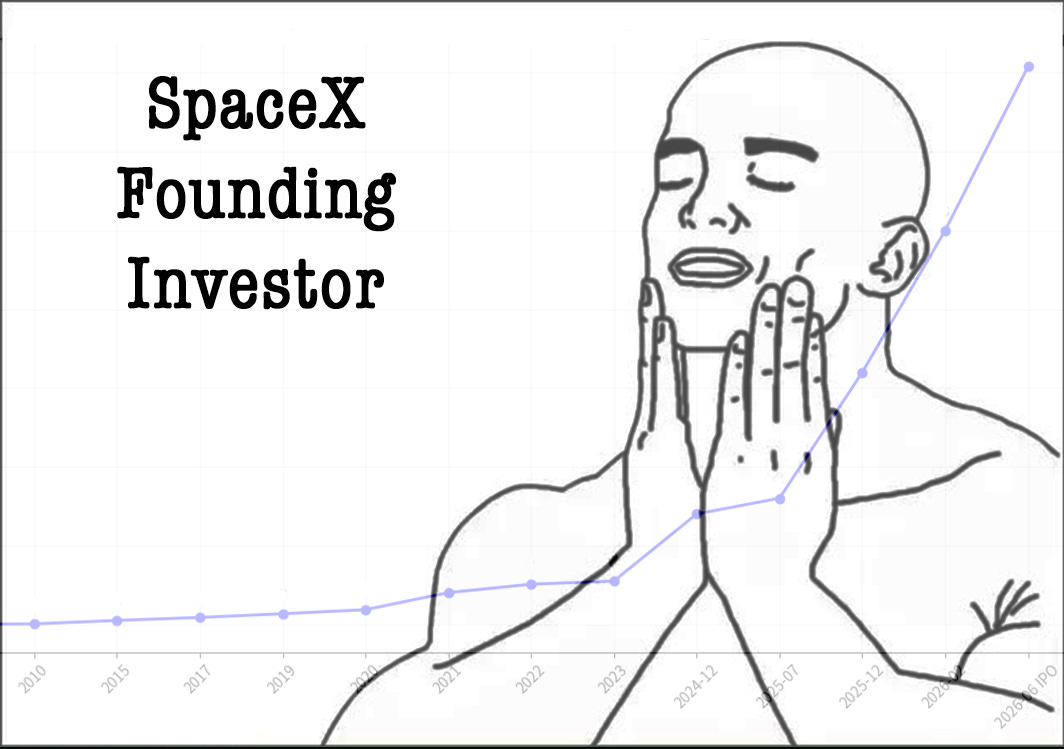
It’s a staggering number, the kind that makes headlines and sparks debates about wealth inequality (here we go again). If we can overcome envy enough to see the inspiration, it’s a testament to bold vision and relentless execution. Musk has delivered reusable rockets that slashed launch costs dramatically and built Starlink into a real business.
It’s the real deal. Space economics is now here.
One person’s paper fortune doesn’t change the math for everyday investors. My hat’s off to the risk-takers who backed him early. But for most working professionals and entrepreneurs, this is a reminder: Extraordinary outcomes come from extraordinary (and concentrated) bets.
Recognize it can be easy to mistake survivorship bias for a repeatable strategy.
Don’t chase the pop unless you’re prepared to be disappointed. If you already have a small allocation, consider your time horizon. Flipping quickly can get you blacklisted from future IPOs at many brokers.
Without an inside edge, diversification should be the rule. Leveraging a hot stock isn’t a reliable path to wealth independence for most people. Lady Luck can be a cruel mistress. When she isn’t, use the gains to rebalance into a broader portfolio. Index funds are fantastic for this use-case. Just don’t forget to weigh the tax consequences first.
SpaceX embodies the American entrepreneurial spirit: high risk, high reward, pushing boundaries. But as we build our own fortunes, remember that sustainable wealth comes from consistent habits, not one-way tickets to the stars.
Investment advice offered through National Wealth Management Group, LLC. The information presented is for educational and informational purposes only and is not intended as a recommendation or specific advice.
This should not be construed as investment analysis, research, or a solicitation regarding SPCX or any specific security. Past performance is no guarantee of future results. Always consult your own advisors.